
‘Barefoot’ is a commonly used term for modern footwear ranges, but it’s one which isn’t actually regulated. At Prenta, we believe that our shoes need to earn the barefoot label, which is why we send our shoes to Umana to be independently assessed by their Footwear Biomechanical Center in Vigo, Spain, using the Extended Minimalist Index Validation.
This is a formal biomechanical assessment that evaluates the footwear against 15 design parameters associated with foot movement, plantar sensory feedback and gait biomechanics.
Every shoe in our barefoot collection has been through rigorous scientific testing to ensure it actually meets the requirements to be legitimately classified as ‘barefoot’. Here’s what that testing actually involves, what the results mean, and how our styles performed.
How we ensure that our barefoot shoes are safe for children and purely barefoot
Any brand can simply put ‘barefoot’ in the name of their shoes. There isn’t a legal definition of this term in footwear, so there’s usually no way to know whether the shoes you’re buying are genuinely good for children.
At Prenta, we ensure that our every style of our barefoot shoes are safe for children because they’re independently assessed by UMANA’s Footwear Biomechanical Center, a laboratory registered as a Healthcare Center for Biomechanical Analysis (licence C-36-001498), rather than a marketing department.
That distance between the people who make the shoe and the people who test it matters. The rating on a pair of Prenta shoes reflects an outside lab’s measurements of the finished product, not a claim we’ve made ourselves.

The testing process for barefoot shoes
Umana scores footwear against something called the ‘extended minimalist index’ (EMI), which is a percentage built up from a set of physical measurements taken from the shoe itself, assessed by a multidisciplinary panel that includes biomechanical engineers, doctors, physiotherapists and podiatrists.
The current protocol, UMANA-IME:2025.11, is based on more than 50 international references, including global anthropometric databases, scientific literature and footwear biomechanics standards, and was presented at the Spanish National Congress of Podiatry in 2025.
Each report breaks the EMI down into four groups of measurements:
-
Sole parameters - Sole drop (the height difference between heel and toe), sole thickness and toespring angle (how much the front of the sole curls upward). A true barefoot shoe stays flat and thin, with next to no upward curl to get in the way of a natural stride.
-
Fit parameters - Toebox shape, width and fastener type, checking there’s room for toes to spread and grip rather than being tapered into a point.
-
Mechanical parameters - Weight, flexion and torsion (how easily the sole bends lengthways and twists). Barefoot shoes are expected to fold and twist almost as freely as bare skin.
-
Stability/control systems - Whether the sole, upper or insole contain any rigid shanks, heel counters or motion-control inserts. For a genuinely barefoot shoe, the answer should be none: the foot does the stabilising, not the shoe.
Each measurement is scored out of 10 and rolled into an overall EMI percentage, which UMANA then bands into a classification.
Testing our barefoot range rigorously before we stock them
Every single barefoot model we stock goes through its own UMANA Extended Minimalist Index Validation before it’s added to the collection.
Because fit can shift slightly across a size run, UMANA tests a representative size from each style.
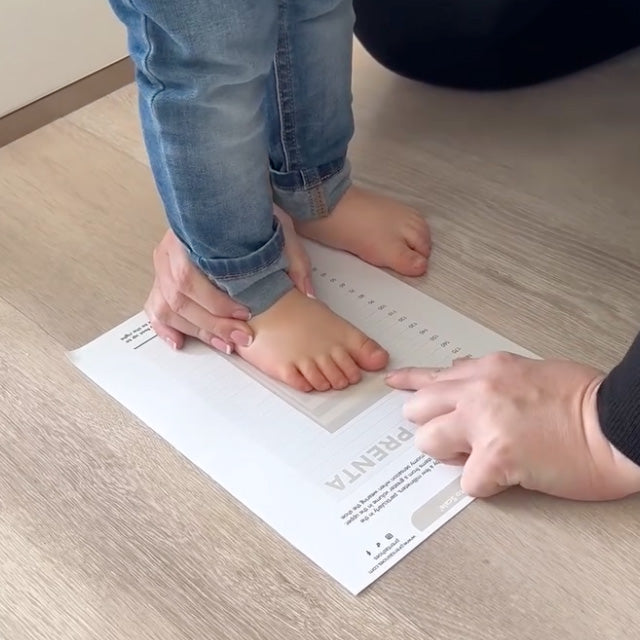
If you're not sure which size that maps to for your child, our size guide (and our guide to measuring their feet at home) can help.
Our barefoot testing results: What they mean
Every style we’ve sent off for testing has come back with the same classification, known as ‘barefoot pure footwear’. This is the top tier rating for footwear that meets the requirements of barefoot shoes across sole, fit, mechanics and stability measurements.
Overall scores are banded from poor up through satisfactory, good, great, excellent and exceptional.
-
Every Prenta style tested so far lands in the exceptional band, with EMI scores between 91.2% and 94.7%.
If you're still weighing up whether barefoot is the right call for the school run specifically, our guide to barefoot shoes for school covers that in more detail. Or, learn about how barefoot shoes are great for everyday wear too!
Below is how each of our styles performed:
-
Ash barefoot school shoe - Ash sets the baseline for our school-shoe range: a dead-flat sole, full-length flex and torsion, and no rigid stabilising parts anywhere in the shoe. EMI 91.5%. Barefoot Pure Footwear, overall score 9.1/10 (exceptional), 152g, toespring angle 5° (negligible).
-
Kai barefoot school shoe - Kai's toespring angle (8°) is the highest of the school-shoe styles tested, but still sits well inside UMANA's ‘negligible’ band alongside a full 10/10 sole score. EMI 91.7%. Barefoot Pure Footwear, overall score 9.1/10 (exceptional), 150g, toespring angle 8° (negligible).
-
Sky barefoot school shoe - Sky gets the highest mechanical score of the school-shoe range (8.9/10), helped by being the lightest of the four at 142g. EMI 92.2%. Barefoot Pure Footwear, overall score 9.2/10 (exceptional), 142g, toespring angle 5° (negligible).
-
Dawn barefoot school shoe - Dawn scores the highest EMI of the current school-shoe range, and is the lightest style tested at this size, at 141g. EMI 92.3%. Barefoot Pure Footwear, overall score 9.2/10 (exceptional), 141g, toespring angle 7° (negligible).
-
Ember barefoot school shoe - Ember is the heaviest style tested at 157g, which brings its mechanical score down slightly (8.5/10), but its overall EMI still lands comfortably in the exceptional band. EMI 91.2%. Barefoot Pure Footwear, overall score 9.1/10 (exceptional), 157g, toespring angle 5° (negligible).
-
Dusk barefoot school shoe - Dusk's brogue-style detailing sits on top of the same barefoot sole construction as the rest of the range. Zero drop, 7mm sole thickness, full flex and torsion. EMI 91.8%. Barefoot Pure Footwear, overall score 9.1/10 (exceptional), 148g, toespring angle 6° (negligible).
-
Elm barefoot first walker - Elm is one of two first-walker styles tested, and posts the highest EMI of any Prenta shoe so far, helped by a featherweight 80g build and a wide, foot-shaped last built for a toddler's broader little foot. EMI 94.7%. Barefoot Pure Footwear, overall score 9.4/10 (exceptional), 80g, toespring angle 9° (negligible).
-
Eden barefoot first walker - Eden mirrors Elm's first-walker construction, 6mm sole, wide last, sub-90g weight, for a mesh-and-leather style due this Autumn/Winter. EMI 94.4%. Barefoot Pure Footwear, overall score 9.4/10 (exceptional), 83g, toespring angle 10° (negligible).
Every one of these results comes from an independent lab, tested on the finished shoe. It’s the same process, the same protocol and the same lab for every style we sell, whether it’s on the shelf today or landing this Autumn/Winter.
Contact Us to Learn More About Our Barefoot Shoes!
You can also scan the below QR code or click this link to go directly to our reports: